黑色皮革手册
4,220-year-old rock art in SW China’s Yunnan reveals early cultural links with Southeast Asia_我的网站

A |
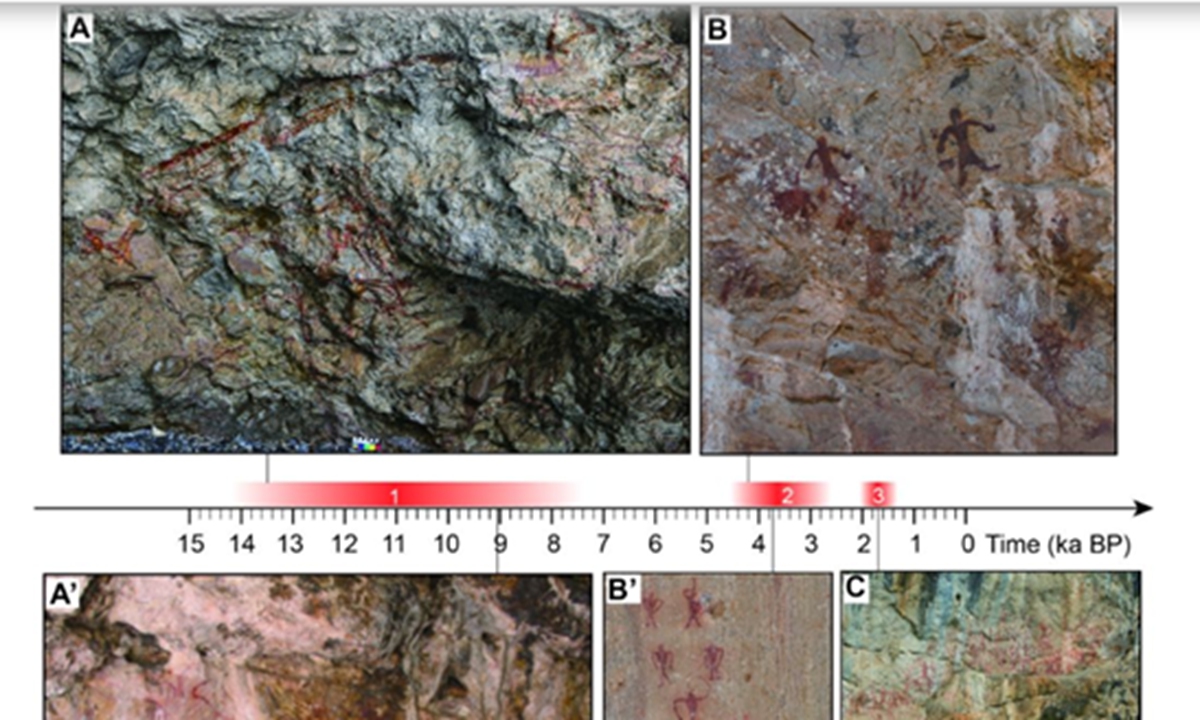
Timeline of the major painted rock art groups in Southwest China: A-A′: Jinsha River rock art; B-B′: Mangguan-Cangyuan rock art; C-C′: Zuojiang rock art Photos: Xinhua
Chinese researchers have obtained the first absolute dates for rock paintings at the Mangguan rock art site in Southwest China's Yunnan Province, pushing the known history of rock art created by prehistoric settled communities in the region back to about 4,220 years ago. The paintings also suggest cultural interactions more than 4,000 years ago between Southwest China and civilizations along the Yellow and Yangtze rivers, as well as possible exchanges with neighboring parts of Southeast Asia, including present-day Myanmar, Thailand and Vietnam, a member of the research team told the Global Times.
The Yunnan Provincial Institute of Cultural Relics and Archaeology, in collaboration with Nanjing Normal University and other institutions, have recently made a significant archaeological breakthrough. Through systematic surveys and uranium-thorium (U-Th) dating at the Mangguan site in Gengma county, the research team obtained the first absolute dates for the site's rock paintings, tracing rock art created by prehistoric settled communities back to around 4,220 years ago.
The findings were recently published in the international journal
Journal of Archaeological Science: Reports.
The Mangguan rock paintings represent one of the best-preserved prehistoric rock art sites in Yunnan. The research team presented high precision U Th dating of carbonate accretions that stratigraphically overlie the painted motifs at the Mangguan site, according to the paper published in the journal.
The dating results show that carbonate deposits overlying a human figure yielded a corrected age of 4,240 ± 19 years before present, confirming that ancient people living in the region had already produced mature figurative art at least 4,220 years ago, Wu Yun, first author of the paper and an associate researcher at the Yunnan Provincial Institute of Cultural Relics and Archaeology, was cited by the Xinhua News Agency report as saying.
Dating results from 11 samples taken from different motifs clustered between about 3,907 and 3,056 years ago. By comparison, the Cangyuan cliff paintings had previously been dated to roughly 3,800 to 2,700 years ago. The Mangguan paintings are therefore significantly older, filling an important chronological gap in the region's artistic record before the Cangyuan phase.
Shao Qingfeng, corresponding author of the paper and a professor at the School of Geography at Nanjing Normal University, told the Global Times that previous estimates dated the Mangguan rock paintings to a little over 3,000 years ago based mainly on imagery and comparisons with similar regional sites. Using microsamples of secondary carbonate deposits overlying the paintings, researchers have now obtained a precise minimum age of about 4,220 years before present without damaging the rock art.
The findings and the establishment of this chronological framework not only strengthen the archaeological foundation for studying rock art in Southwest China, but also provide a direct reference for rock art sites across Southeast Asia that have yet to undergo systematic dating, Shao said.
The findings may also challenge long-held perceptions of Southwest China around 4,200 years ago - roughly the era of the Xia Dynasty (c.2070 BC-C.1600 BC) - and help fill a key gap in understanding the pluralistic yet integrated development of Chinese civilization.
Shao said that while academic research has traditionally focused on the Yellow River and Yangtze River basins as cradles of early Chinese civilization, sites such as Mangguan and Cangyuan show that stable and culturally active communities also thrived in mountainous Southwest China. The newly established rock-art chronology brings an artistic dimension to the broader narrative of China's enduring cultural development.
Moreover, stylistic similarities suggest that Southwest China maintained exchanges with the Yellow River and Yangtze River regions and with early societies in Southeast Asia, providing material evidence of cross-regional interaction more than 4,000 years ago.
。 夏日炎炎,涉水徒步、溪流穿越等户外活动热度高涨,EVA溯溪鞋凭借独特优势,成为众多年轻消费者追捧的户外装备。为回应消费热点、引导理性选购,杭州市消费者权益保护委员会(以下简称“杭州市消保委”)联合必维申美商品检测(上海)有限公司,开展了EVA溯溪鞋比较试验。本次比较试验采用“问卷调查、客观测试、消费者体验”三位一体联动模式,以普通消费者的身份,从线下实体店及各大电商平台共购买了27款样品,包括运动品牌、快时尚品牌、户外品牌及电商平台中销量较高的品牌等,样品单价从9元到303.99元不等。购买渠道包括杭州实体商场和主流,其中电商平台覆盖天猫、京东、唯品会、得物、抖音等平台。本次比较试验27款样品的特性项目指标总体呈现中等水平,在轻便性、耐摩擦色牢度、鞋底硬度等方面表现良好,但部分样品在防滑、耐磨、压缩变形等耐用性指标上仍有提升空间,部分样品的标识存在信息缺失或不规范的情况,有待进一步规范。防滑性能测试结果显示,前掌防滑性能略优于后跟,但差距不大;干态优于湿态,湿态防滑性能相比干态平均下降22.6%;大部分样品干态防滑性能良好,能满足日常干燥路面使用;湿态防滑平均值为0.494,能满足日常溯溪场景需求。耐磨性能直接影响溯溪鞋的使用寿命。数值越低耐磨性能越强。测试结果显示,27款样品不同品牌之间差异较为明显。结果显示,27款样品均在三星及以上,其中16款样品达到四星及以上,标称品牌分别为:MERRELL迈乐、SENMA森马、安踏、乔丹、CROCS、XTEP特步、回力、朴西、红豆、TZLDN/利达妮、SKECHERS斯凯奇、海澜之家HLA、DECATHLON、匹克、HUMTTO悍途、MINISO。

B | 链接:杭州市消保委发布消费提醒按需选型,聚焦实用性能选购EVA溯溪鞋时,应结合日常休闲玩水、专业溯溪、短途徒步等实际场景,明确自身需求。重点检查鞋头防撞、脚踝支撑、防滑大底、排水结构等核心配置,确保鞋子具备实用性能。同时,根据自身脚型挑选合脚款式,避免磨脚、易进砂石等常见问题,切勿盲目跟风网红款式,确保选购的溯溪鞋既实用又舒适。理性甄别宣传,规避营销陷阱面对商家宣传,需保持理性,客观看待产品内容。仔细查看鞋材用料、性能参数等相关说明,警惕夸大防滑、耐磨、速干等功能的不实宣传。

C | 必要时,可参考实际评测、官方选购指南等权威信息,辅助决策,避免陷入营销陷阱,切实维护自身消费权益。(通讯员 杭小消 记者 汪晓筠)。
Current article:http://qigh.focuolequzenkedenchaoruaxing.pics/r94e/cdgp.html
Published on:00:46:22

 100架!国产大飞机C919再签新订单
 袅袅草药香 悠悠润童心——猎德幼儿园大班亲子走进省博开展中草药探秘之旅
 水培10万株刺嫩芽杆
 工信部定调脑机接口标准化发展路线图 多只概念股业绩有望倍增(名单)
 广州每日优鲜主要人员变更 此前曾被列入经营异常名单_该公司_名录
 中国商业航天企业首次面向东南亚整星出口!银河航天三颗卫星发射成功
查看所有0条评论>>